A five-year project to investigate and widen the impact of mixed-ability communities of friendship
Background to the project: the Lyn’s House Community
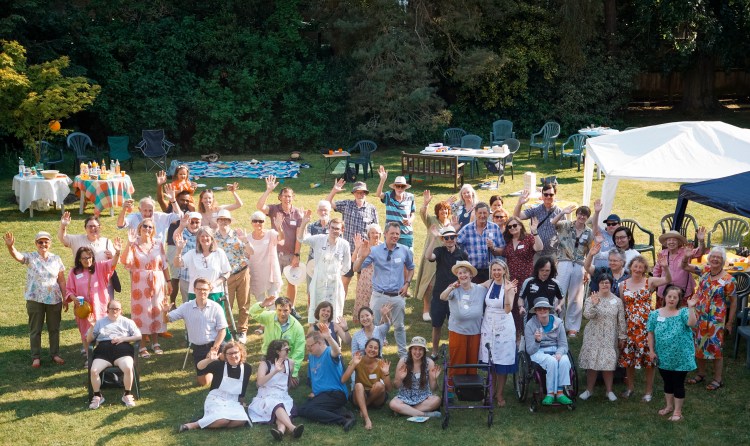
Lyn’s House is an ecumenical Christian community of people with and without intellectual disabilities in Cambridge. It was founded in 2013 not as a care provider but as a community of friendship and encounter across a particular form of human difference. The concept and practice of friendship – across a significant form of human difference which too often produces mutual distancing and alienation – has been the guiding principle of Lyn’s House from its inception. Friendship has been understood and practiced in Lyn’s House as mutual hospitality and welcome between people of widely differing intellectual abilities, which require time, attentiveness and a willingness to be open to each other. People of all intellectual abilities have described belonging to Lyn’s House as a unique and transformative experience for their lives and faith, while finding it hard to say exactly why. Some of this testimony is recorded and explored in our 2020 book ‘A Kind of Upside-Downness’. It suggests that something important happens in Lyn’s House which is not easy to describe and account for, but which merits investigation. This has led to the Growing in Friendship research project.
Our approach and partnerships
Growing in Friendship is a research project established by the Trustees of Lyn’s House to broaden and deepen enquiry into the experience of belonging to Lyn’s House. The project is located in the University of Aberdeen’s Centre for Spirituality, Health and Disability, a world-leading research centre. The overarching methodology is Theological Action Research, an approach to qualitative practical-theological research in which the researched community or group participates actively in the entire research project: from inception and research design, through reflecting on and interpreting data, and on to dissemination. Members of Lyn’s House will be participants in the research, rather than simply being its object. Growing in Friendship will use both traditional and non-traditional methods of research, of reflection on data, and of dissemination to maximise meaningful participation in all parts of the project by people across the Lyn’s House community. The Project Leader Revd Dr Carole Irwin is employed by Aberdeen University as a Research Fellow and works closely with the Centre’s Director, Professor John Swinton, who is her line manager. Carole has been a member of Lyn’s House since 2018 and is based in Cambridge. Carole is also a Research Associate of the Von Hügel Institute at St Edmund’s College in the University of Cambridge, and a participant in the Institute’s five-year research project Disability, Knowledge and the University in partnership with the University of Notre Dame.
Project output
We will disseminate the research findings of the Growing in Friendship project in order to communicate and share what we learn. Here again, members of Lyn’s House will participate in this part of the project. The project also anticipated practical outcomes based on the research-findings. The learning will be used to foster and resourcing creative improvisations on the Lyn’s House model in other settings, including universities, churches community groups. Artistic output is among anticipated non-traditional forms of dissemination of findings, which will enable the participation of all members of Lyn’s House in sharing the project’s findings. This could involve collaboration with artists, film-makers, cartoonists etc. As well as producing resources for the formation of similar communities elsewhere, the Growing in Friendship project aims to develop resources for faith- and ministry-formation alongside people with intellectual disabilities in theological education programmes and institutions. This could include a first-year undergraduate-level award in theology for a mixed ability cohort of students.
Projected timeline of the project
The project is planned to run for five years from 2023 to 2028.
Year one (2023-2024)
Designing the project and research methods with the Lyn’s House community; ethical approval.
Year two (2024-2025)
Actively engaged in practical-theological qualitative research with members of Lyn’s House. The reflective process will also start in year two, as data is produced. At least one peer-reviewed paper in an academic journal, and one article in a non-academic journal or periodical.
Years three to four (2025-2027)
Completion of the qualitative research and reflection on data. Writing up, and distillation of material; dissemination in academic, professional/practitioner, third sector and community-based publications. Dissemination using non-traditional methods, including drawing in expertise and potential collaborators from the arts, drama/theatre, film-making etc. Actively seeking feedback.
Years four to five (2027-2028)
Building on research findings and feedback from dissemination to advocate for communities like Lyn’s House, and to produce resources to enable the founding of other such communities. Developing formational pathways in theological education alongside people with intellectual disabilities and a mixed-ability award in Christian theology, initially in Cambridge.
Funding
We have secured £147,000, with grateful acknowledgement of the generosity of the Sir Halley Stewart Trust and the Charles Plater Trust, and to those who have made personal donations. We continue active fundraising.
Get in touch!
If you would like to support the project, or would like to find out more, please contact the project leader Dr Carole Irwin using the contact form below.


 lynshouse.org